Teaching practitioners to read the body, not the protocol.
For more than three decades I’ve taught experienced practitioners — massage therapists, physical and occupational therapists, chiropractors, osteopaths, and physicians. What I bring to a school or an organization isn’t a new set of techniques. It’s a way of seeing: The Ankrum Method.
Practitioners who have outgrown formulas.
The people who seek this work out are already skilled. What they’re missing is the layer underneath the techniques — the principles that let a practitioner follow a body to the system where the problem actually lives. That layer is what I teach.
Massage & bodywork therapists
Experienced hands who have outgrown protocol-based work and want the principle-level depth their first training never reached.
Physical & occupational therapists, chiropractors
Clinicians looking for a rigorous manual framework for the cases that don't resolve — where the origin lives in a system far from the symptom.
Osteopaths & physicians
Practitioners of the osteopathic tradition who want deeper specialist material — visceral work, the diaphragms, the cranial field — taught from principle.
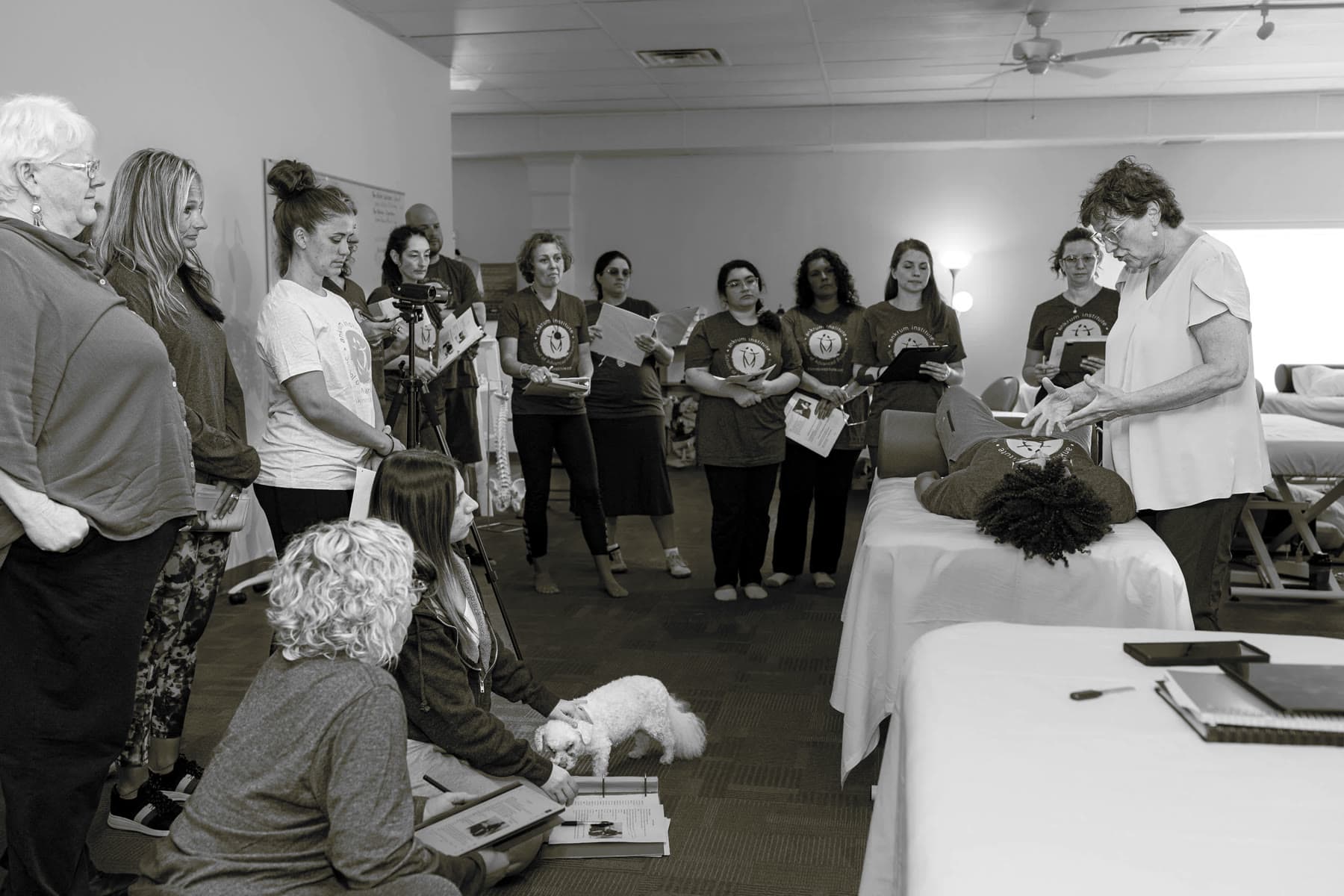
Functional Bodywork rooted in osteopathic principles.
Five modalities under the osteopathic umbrella — craniosacral, osteoarticular, functional normalization, muscle energy, and visceral manipulation — held together by a single discipline: listen first, and let the body show you the plan.
- The treatment plan is in the body. You don't bring a plan to the body — you let the body show you the plan.
- A treatment sets something in motion that keeps working long after the session ends. The work is a process, not an event.
- Treat the whole, not the part. The origin of a problem often lives in a system far from where the pain shows up.
- The systems of the body are in constant relationship — organ to muscle, membrane to bone, pressure to structure. Read the relationships.
- No formulas. The aim is practitioners who think — who can meet a body they've never encountered and know how to proceed.
A lineage your faculty can stand behind.
This work wasn’t assembled from weekend courses. It rests on a five-year osteopathic education, a decade of assisting a master teacher across three continents, and thirty-plus years of practice — distilled, since 2016, into the curriculum of the Ankrum Institute.
Graduates of the Institute’s program have, to date, passed the national massage & bodywork licensing exam (MBLEx) at an exceptional first-time rate — a small, quiet proof that teaching principles works.
In continuous practice, and founder of the Ankrum Institute — a school of functional bodywork in Tulsa, Oklahoma.
Osteopathic training at the Canadian College of Osteopathy. (Leigh practices under a massage therapy license; she is not an osteopath or physician.)
Taught with Michael Shea across three continents; biodynamic craniosacral training with Franklyn Sills at the Karuna Institute in England (1998–99).
Twelve years as teaching assistant to a leading craniosacral educator, teaching practitioners across the US, Canada, and Switzerland.
Four ways to bring the work to your people.
Guest lectures
A single session inside your existing program — in person or online. A focused topic, taught from principle, shaped to your cohort's level.
CPD workshops
Hands-on professional development for practising clinicians — a day or a weekend on one territory of the work, at genuine depth.
Multi-day intensives
Immersive trainings for schools and practitioner communities who want the method itself — the way of seeing, not just a technique set.
Faculty collaborations
Ongoing teaching relationships with schools and institutions — recurring visits, specialist modules, and work alongside your faculty.
Every engagement is shaped with you — topic, depth, and format matched to your cohort. For talks, interviews, and media, see Speaking & collaboration.
A note for UK osteopaths
Under the General Osteopathic Council’s CPD scheme, UK osteopaths choose learning relevant to their own practice and record their hours themselves. Practitioners attending my workshops and intensives may find them a natural fit for that self-directed professional development. To be plain: my teaching is independent — it is not accredited, approved, or endorsed by the GOsC or any other regulatory body.
Bring Leigh to your school or organization.
Tell me about your program, your practitioners, and what you’d like to give them. I read every message personally — and I’m especially glad to hear from schools in the UK, Europe, and New Zealand.